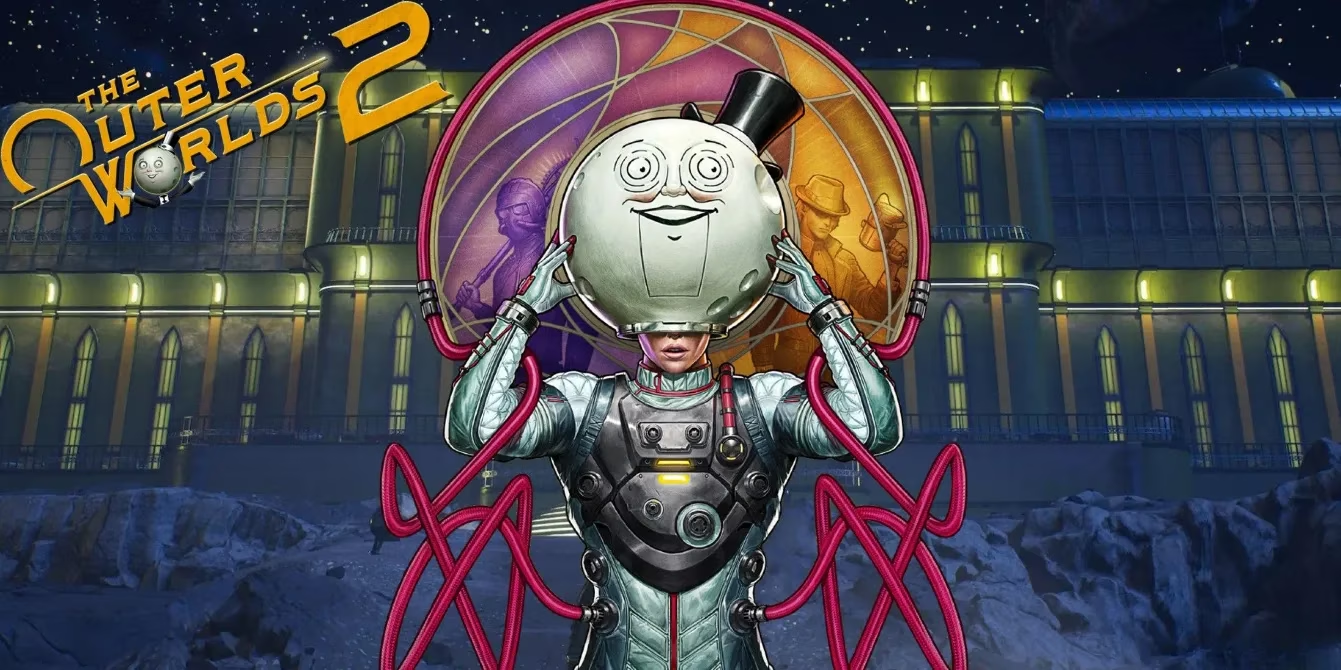
By 2026, The Outer Worlds 2 no longer belongs to the fog of pre-release speculation. Obsidian Entertainment’s sequel arrived in late 2025, and the conversation has shifted from guessing whether the studio would lean into comedy to examining how that comedy functions. The first game’s satire of Halcyon—a star system owned and explored by corporations—was its signature: a dark future wearing a grinning corporate mascot like a carnival mask stretched over a ledger. The sequel’s decision to leave Halcyon behind did not remove that target. It simply changed the scenery. The anti-corporate satire must remain intact, even if the corporations, mascots, and boardroom slogans are new.
A Sequel Carries a Satirical Burden
Sequels carry a heavy burden, especially when they follow an experience as distinctive as The Outer Worlds. Obsidian announced very little about the sequel’s story before launch, but the studio did confirm that the Halcyon system would be left behind. That raised an obvious question: how can a game keep its anti-corporate themes while exploring a star system that is not already synonymous with corporate ownership? The answer lies in thematic unity. Some corporations may be left behind, but the satire about them must remain intact. The Outer Worlds 2 can change its map without changing its spine.
This is not to say the sequel cannot take itself seriously. A balance of comedy and reality is essential. Playing things too safe could harm the game just as much as going overboard on jokes. Obsidian can let comedy drive parts of the story without turning the entire experience into a nonstop gag reel. The franchise’s best trick is that it knows its themes are controversial, so it uses humor to mask that controversy. Without a clear focus on satire, the game risks becoming preachy rather than entertaining.
Avowed as the Serious Counterweight
Obsidian’s Avowed, a standalone fantasy set in the world of Pillars of Eternity, arrived earlier in 2025 and gave the studio a more serious counterweight. Even if Avowed’s story does not lean heavily on previous games, working within an existing IP imposes restraints. Obsidian likes to have fun, often leaving Easter eggs, jokes, and comedy in its games. Avowed could include some of that, but it had to play it safe. A fantasy world with established lore is not the place to detonate the furniture for a laugh.
That restraint matters. If Avowed had to remain more serious in tone than Obsidian typically likes, the company needed an outlet for its pent-up silliness. The Outer Worlds 2 is that outlet. Under its own original IP, Obsidian faces fewer restraints. It only has to answer to fans of the first game, who already enjoyed the satire included there. This is one advantage the company gained by working on both Avowed and The Outer Worlds 2 at the same time. Sometimes companies face restraints that disallow them from doing what they really want to do, but with The Outer Worlds 2, Obsidian can, and should, be silly.
| Pressure Point | Avowed | The Outer Worlds 2 |
|---|---|---|
| IP constraint | Existing Pillars world; tone must fit | Original IP; freer to be silly |
| Comedy outlet | Easter eggs and light jokes | Satire can drive the story |
| Main risk | Disappointing lore-focused fans | Becoming preachy or toothless |
| Best use of humor | Flavor and discovery | A whoopee cushion slipped under a boardroom chair |
Silly, but with a Scalpel
The Outer Worlds 2 can use comic helium without floating away from its critique. The ideal sequel is not a nonstop joke machine; it is a satirical pressure cooker. Humor can be the lacquer on a trapdoor, making the corporate dystopia entertaining before the floor gives way to a sharper point. The first game’s quippy mascots and dark warnings worked because the jokes had a target. The sequel needs that same aim. If it abandons satire, it risks becoming a colorful tour of space oddities. If it abandons silliness, it risks becoming a lecture in a spacesuit.
In 2026, the sequel’s reputation hinges less on how many jokes it tells than on whether those jokes have a spine. Obsidian does not need to take The Outer Worlds 2 too seriously, because the franchise’s fans already understand the bargain: the comedy is the crowbar, and the anti-corporate critique is the door it opens. The studio can be silly. The studio should be silly. The only real mistake would be forgetting why the silliness mattered in the first place.