When you think of a truly memorable RPG, what first springs to mind? More often than not, it’s the companions who walk beside you—friends, rivals, and found family that breathe life into every quest. Obsidian Entertainment has long been a master of this art, from the complex souls of Pillars of Eternity to the unforgettable crew of The Outer Worlds. With Avowed, their first-person fantasy epic set in Eora’s Living Lands, the studio doubled down on creating a party that’s just as rich and surprising as the world itself. Game Rant sat down with director Carrie Patel, narrative designers Paul Kirsch, Jay Turner, and Katie Tenney, and other key devs to peel back the curtain on how Kai, Marius, Giatta, and Yatzli came to life—and what makes each of them so much more than a combat archetype.
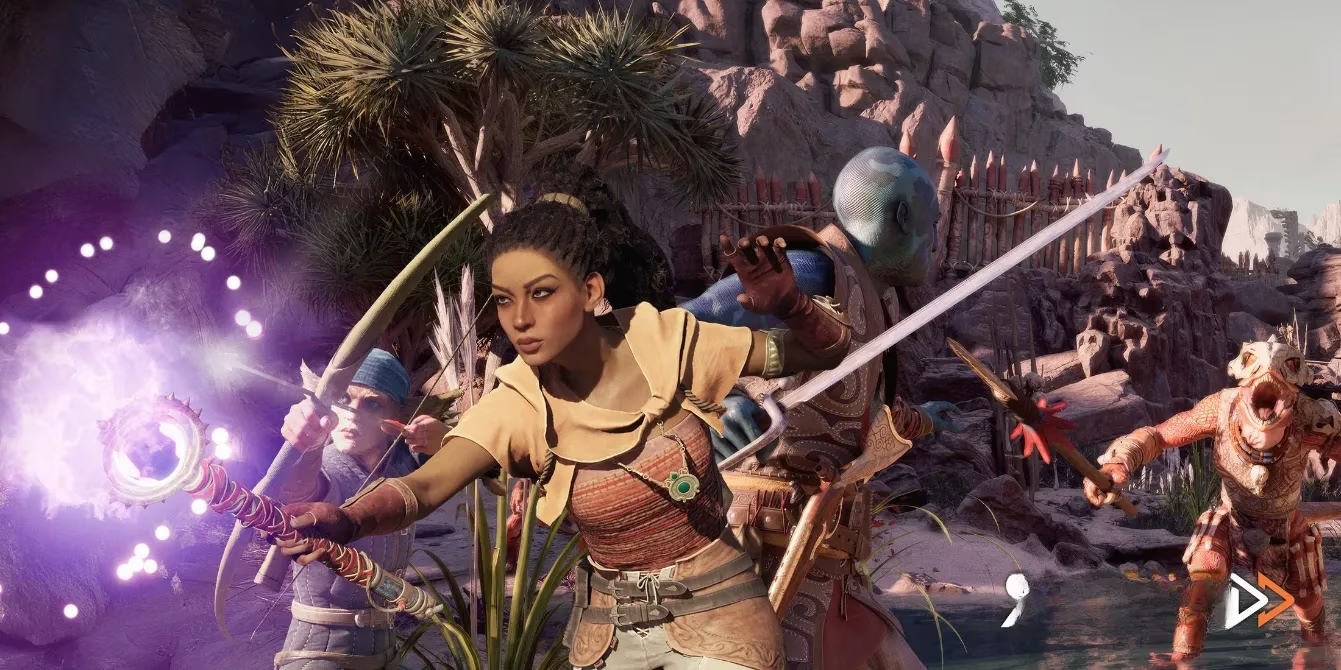
The Philosophy Behind the Party
From the very top, Obsidian knew companions in Avowed had to wear many hats. They’re not just extra swords in a fight; they’re ambassadors for the wider world, lenses through which players can understand the tangled politics, cultures, and metaphysical mysteries of the Living Lands. Narrative designer Paul Kirsch put it simply: “We want them to highlight something about the setting, so the player has a well-rounded point of view about the sorts of choices they’ll be making and the people impacted.” But beyond that educational role, each companion is a protagonist in their own right—with personal goals, secrets, and flaws that might clash with your own path. One minute you’re sharing a laugh around the campfire, the next a companion is questioning your morals or calling you out. That push-and-pull makes every decision feel weightier, as if real friendships hang in the balance.
Kai, the first companion the player meets, was always envisioned as a Rauataian ex-mercenary with a checkered past and a hidden warmth. The team deliberately made him affable and humorous—a brother-in-arms who could ease players into the world without being a bland “yes man.” Yet even he has his limits. Director Carrie Patel noted that some of her favorite writing moments came when the player can find the edges of Kai’s easygoing nature, those raw nerves that reveal a man still grappling with heartache and regret. Voice actor Brandon Keener—whom RPG fans will instantly recognize as Garrus Vakarian from Mass Effect—brought a rugged vulnerability to Kai that makes both his jokes and his silences land.
Marius, the lone-wolf hunter and tracker, started off as a far simpler concept: a wilderness expert with rogue abilities. But Jay Turner, who wrote him, expanded that kernel into a deeply personal arc. Marius has spent so long operating outside society that he’s forgotten how to be around people—his deadpan sarcasm an armor against getting too close. “He’d rather be left alone,” Turner admitted, “but no man is an island, and that goes for Marius as well.” His journey isn’t about suddenly becoming a chatterbox; it’s about learning that relying on others doesn’t make you weak. In a party that can sometimes feel like a chaotic family, Marius is the grumpy uncle whose quiet loyalty runs deeper than any roar.
Then there’s Giatta, the animancer scientist who heals and shields the group. Animancy—the study of souls—is one of Eora’s most fascinating (and feared) disciplines, and Kirsch poured a lot of thought into making Giatta feel like more than just a walking lab coat. “I like to think of animancy as science in a world that hasn’t quite figured out the scientific method yet,” he said. It’s messy, philosophical, and often perilous. Giatta carries a personal crusade: her parents died in a lab accident, and she’s driven to finish their work and redeem their mistakes. That guilt makes her clinical one moment, defiant the next. Over the course of development, Kirsch deliberately spiced her up, giving her a sharper tongue and a fiercer resistance to authority. The result is a companion who can argue politics with Kai, share ghost stories that make him squirm, and engage Yatzli in intellectual sparring sessions that feel like a supernatural book club.
Speaking of Yatzli, the Godless expert is easily the most mischievous of the bunch. Her personality was locked in from the first moodboard, which mixed Indiana Jones’ adventurous spirit with Harley Quinn’s chaotic energy. Narrative designer Katie Tenney, who took over her writing, leaned hard into Yatzli’s fun, flirty nature and her loving relationship with her partner. But Yatzli also wrestles with something deeply relatable: the parts of ourselves we leave behind as life rushes past. Tenney, who returned to college later in life, infused that same vulnerability into Yatzli. “I’ve always had a soft spot for characters who are still unsure even into their later years,” she shared. As an orlan—Eora’s pixie-like, dual-toned race—Yatzli also had to be painstakingly translated from isometric portraits to full 3D. The first batch actually scared some developers, but after a rework, orlans like Yatzli and the beloved Garryck became fan favorites. She’s the fun aunt Giatta never had, the playful thorn in Marius’s side, and a walking explosion of both magic and personality in combat.
Banter, Bonds, and a Shared Campfire
How do these four vastly different people actually get along? In true Obsidian fashion, the party camp becomes a pressure cooker for some of the game’s best dialogue. Marius and Yatzli might seem like fire and ice, but listen closely and you’ll hear a curious friendship buried under the teasing. “Yatzli likes to poke at Marius,” Tenney said. “She can see that there’s more to him and is showing her support in a roundabout way.” Marius, the king of the dry remark, has no idea how to handle her, but there’s respect there. Meanwhile, he and Kai are old buddies from Marius’s days as a wilderness guide, a history that lets them bicker like brothers without ever losing trust. Giatta looks at Marius and sees a vibrant soul weighed down by old scars, so she gently nudges him to live a little—though she respects his boundaries enough not to pry too hard. Yatzli and Kai, both quick to use humor as a shield, sometimes push each other’s buttons precisely because they’re so similar. These dynamics don’t just fill silence; they make the world feel lived-in, as if the companions keep existing even when the player isn’t watching.
Of course, all that banter pays off in the companion quests, which are anything but side content. Every personal storyline is woven directly into the critical path. Turner revealed that Marius’s arc was locked down early, but he gained layers as writing progressed. Similarly, Giatta’s recruitment in the lush Emerald Stair region is intrinsically tied to the main campaign—players learn about her from multiple angles before she joins the party, and her personal trauma makes the region’s story hit harder. Yatzli’s expertise on the Godless meant her quest became a focal point of an entire region’s plot. For Kai, his hidden regrets blossom into a quest about heartache that might just leave players emotional. These aren’t lengthy asides; they’re the emotional spine of the Envoy’s journey.
Combat Charm and Campfire Comforts
What would a companion-based RPG be without unique combat roles? Lead area designer James Agay gave each party member a distinct battlefield identity. Kai, ever the tank, has a passive skill called Second Wind that can revive him to half health if he goes down—because his main job is getting hit so you don’t have to. He can also taunt and stun enemies with Fire and Ire, and his exploration ability lets him burn away obstructions (though a well-placed fire spell works too). Giatta is the ultimate support animancer: she can heal, shield, buff speed, and even activate Essence Generators around the world with her Spectral Jolt. Yatzli is a magical artillery piece—explosions, illusion dispelling, and volleys of missiles, all with enough attitude to sell the mayhem. Marius provides ranged damage, rooting enemies in place, slowing them, and even learning Shadow Step to vanish and reappear with daggers bared. Put them together, and you’ve got a party that’s not just effective but bursting with personality, even in the heat of battle.
The party camp acts as the glue for all these systems. It’s the one safe zone where companions debrief after major events, gossip about your decisions, and advance their personal stories. Since it’s also where you craft, cook, and upgrade weapons, players naturally return again and again, often finding fresh conversations waiting. Kirsch emphasized Giatta’s voice actor Mara Junot, who alongside director Katelyn Gault found layers in her performance that deepened the character far beyond the script.
Fresh Eyes, Old Souls
Even if Avowed stands confidently on its own, it remains deeply rooted in the Pillars of Eternity universe. For veterans, there are callbacks to the Aedyran Empire, Steel Garrote inquisitors, and animancy’s checkered history. Newcomers won’t feel lost, though. A built-in lore glossary lets you highlight unfamiliar terms during dialogue, and the Living Lands—a continent not fully explored in previous games—offers a genuinely fresh start. As Patel put it, “Veterans will recognize the references, but newcomers won’t feel like they’re missing any required reading.” That said, if tactical, isometric RPGs are your thing, the Pillars games remain gorgeous entry points into Eora, and Obsidian still supports them to this day.
The human (and orlan, and aumaua) touches extend to the developers themselves. QA engineer Lindsay Pimintel recalled playing a cranky old scholar named Petunia who was a total jerk to everyone, just to stress-test the narrative. Another playtester once shot a ghostly illusion mid-sentence, sending her tumbling into a chasm—a moment that broke the game in the best way. QA analyst Claire Nentarz spent ages perfecting a wizard character she named “melon” (runner-up names: “Toyotathon” and “xbox360”) and roleplayed her as a living bizarre wizard meme, solving every problem with fireball and mystic ramblings. Patel, who relished playing a taciturn Aedyran loyalist, was delighted by how consistently the game let her be the villain.
As for the future? Patel made it clear the team’s full focus remains on Avowed itself, with DLC neither on nor off the table, just a distant maybe. For now, the companions—Kai’s hidden warmth, Marius’s slow-to-bloom trust, Giatta’s crusade-tinged intellect, and Yatzli’s irrepressible spark—stand as proof that Obsidian hasn’t lost its touch. They’re more than a checklist of party roles; they’re the beating heart of a world that, three years after launch, still begs to be explored.