I still remember the first time I stepped into the Living Lands in Avowed. It was early 2025, and like many dark fantasy RPG fans, I had spent years wondering whether Obsidian Entertainment could translate the soul of Pillars of Eternity into a first-person, action-driven adventure. Now, in 2026, after multiple playthroughs and a year of patches, I can say the game's open-zone structure is not a limitation I merely tolerate. It is one of the main reasons I keep coming back.
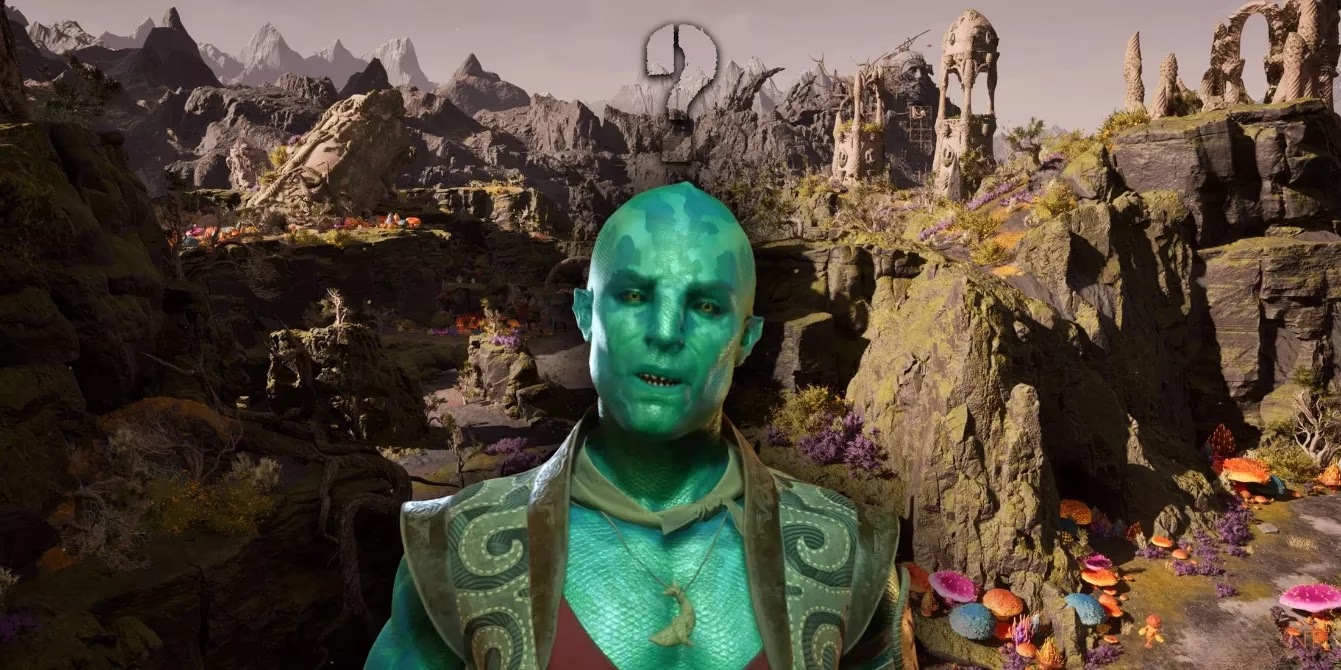
An Eora Unlike Any I Had Explored Before
Avowed sends me to a never-before-seen area of Eora, the Living Lands, to investigate a mysterious disease overtaking the region. From the first moments in Dawnshore, the game made it clear that this was not going to be a seamless continent-sized sandbox like Skyrim. Instead, Obsidian described its map as open-zone, and that design choice shapes everything: combat, questing, loot, companion banter, and the way I emotionally invest in each location. The Dreamscourge is not just a plot device; it is a pressure that makes every new zone feel dangerous, strange, and worth saving.
Open-Zone, Not Open-World: The Outer Worlds DNA
According to the designers, each major region of Avowed's map unlocks through story progression, much like Obsidian's 2019 sci-fi title, The Outer Worlds. In practice, that means I cannot simply sprint from the first beach to the final dungeon. I need to advance the narrative, earn access, and let the world reveal itself. At first, that might sound discouraging for players who want total freedom from the start. I felt that tension too, especially after years of open-world RPGs training me to climb every mountain and ignore the main quest for forty hours.
But the more I played, the more I appreciated the rhythm. The regions are not tiny corridors. They are wide, layered, and packed with verticality, hidden caves, bounty targets, and environmental storytelling. The gating does not feel like a wall; it feels like a chapter break.
| Aspect | Typical Open-World RPG | Avowed's Open-Zone Design |
|---|---|---|
| Initial access | Entire map often available | Regions unlock through story |
| Pacing | Player-driven, sometimes uneven | Curated, narrative-driven |
| Content density | Can feel spread thin | Each zone feels handcrafted |
| Exploration reward | Freedom to wander | Secrets, quests, and NPCs per region |
| Comparison | Skyrim, modern sandbox RPGs | The Outer Worlds, classic hub-based RPGs |
The Case Against Gated Exploration
I will not pretend the system is flawless. There are moments when I want to cross a border because I can see a shimmering chest or a suspicious ruin on the horizon, only to be told that the story has not opened that path yet. That can feel restrictive, even artificial, if the narrative justification is not strong enough. Players and their characters need believable reasons to be prevented from traveling freely. If the game simply says no without a convincing in-world explanation, the illusion breaks. Avowed mostly handles this through its main quest and the dangers of the Living Lands, but I understand why some players bounce off the feeling of being halted until certain plot points are met.
There is also the comparison problem. Fair or not, Avowed will always be measured against Skyrim and other contemporary open-world games. A more limited scope can look like a step backward to someone who values boundless exploration above all else. I have friends who love the genre precisely because they can ignore the story and disappear into the wilderness. For them, Avowed's structure is a trade-off, not a triumph.
Why Curated Regions Feel More Rewarding
On the other side of the equation, some open-world games are so massive that they feel overwhelming. They are packed with items that distract from the core narrative, and they can give the sensation of being a mile wide but an inch deep. Avowed's gated regions avoid that trap. Because I cannot see everything at once, I spend more time in each area. I scour cliffs for treasure, listen to side conversations, and follow rumors that lead to optional bosses. The zones feel curated rather than generated, and that makes the exploration feel personal.
This approach also plays to Obsidian's strengths. The studio is known for rich lore, memorable companions, and choices that ripple through dialogue and quests. When progression rewards me with a new region, it feels substantial. New areas come with their own quests, NPCs, and mysteries. Each locale gets its time in the spotlight. Dawnshore taught me the basics, Emerald Stair deepened the politics and magic, Shatterscarp tested my combat build, and Galawain's Tusks pushed my decisions to their limits. By the time I reached the later zones, I felt like I had earned them.
How 2026 Updates Changed My View
Now in 2026, after a year of patches and quality-of-life improvements, Avowed feels smoother than it did at launch. Combat feedback, companion behavior, loot progression, and performance have all been refined. The open-zone philosophy, however, remains the same. That is telling. If the structure were truly a weakness, Obsidian could have patched it into a more conventional open world. Instead, the game doubles down on what makes it distinct: intimate regions, strong narrative pacing, and exploration that rewards attention rather than sheer distance.
I recently started a new playthrough on a higher difficulty, and I noticed how much I still enjoy the moment when a new region opens. It is not just a map expansion. It is a promise: more secrets, more danger, more strange gods and stranger people. That promise keeps me engaged in a way that a fully unlocked map sometimes does not.
A Memorable Journey Through the Living Lands
Avowed may not be the endless sandbox that some players wanted, but as a dark fantasy RPG, it understands something important: not all freedom is spatial. Freedom can be the choice to solve a quest through diplomacy, stealth, or violence. It can be the choice to bring one companion instead of another. It can be the choice to explore every corner of a region before moving on. The open-zone map supports those freedoms by giving each area room to breathe.
So, if you are like me and you have been comparing Avowed to Skyrim since its 2020 announcement, I suggest adjusting your expectations. Do not measure it by how many miles you can walk without a loading screen. Measure it by how many stories you remember after the credits roll. In 2026, with the Living Lands fully mapped in my memory, I can say that Avowed's open-zone progression is not a step back. It is a different path, and for me, it leads somewhere memorable. 🎮🗺️⚔️