No class, no problem. When a gamer first stepped into the vibrant and perilous Living Lands of Avowed in early 2025, they were immediately met with a question that most role-playing games pose upfront: “What class will you choose?” But in Obsidian Entertainment’s latest fantasy epic, that question never came. Instead, the character sheet was a blank canvas, waiting to be painted with choices made in the heat of battle and the thrill of exploration. Nearly a year after its release, Avowed continues to be celebrated for this liberating design, a philosophy that Lead Area Designer James Agay described as putting “player choice first.”
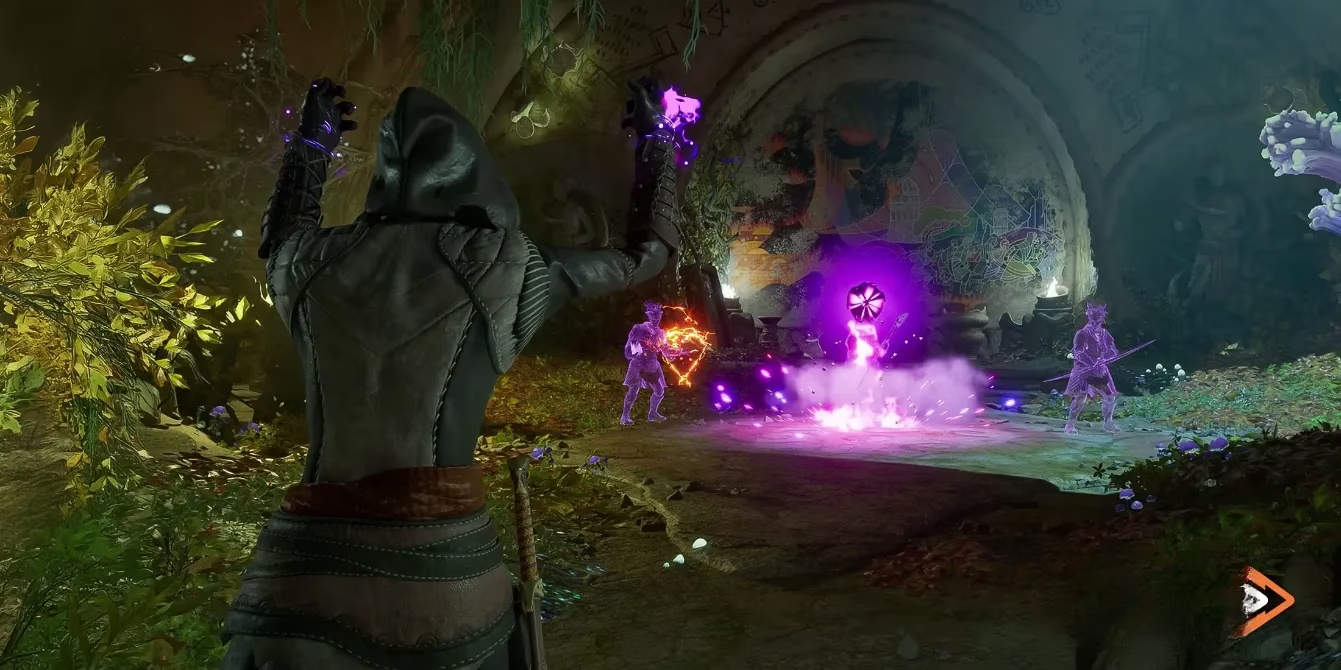
The Pillars of Eternity universe had always been home to rigid character classes, and initially, Avowed followed that tradition. But during development, the team realized that locking players into a fixed archetype before they even understood the world felt too constraining. “We don’t want to limit most players' experiences by a choice they made before they started playing and when they had little game knowledge,” Agay explained. Thus, the classless system was born, allowing anyone to seamlessly blend swordplay, spellcasting, and stealth into a personalized hero. The classic RPG roles – fighter, ranger, wizard – became but a spectrum, and each adventurer was free to find their own sweet spot within it.
That freedom is anchored by four distinct skill trees. The Fighter tree emphasizes defense, damage mitigation, two-handed weapons, and mobility. A player who goes deep into this path can become a Barbarian, leaping into the fray with a massive axe and charging through enemies with raw force. The Ranger tree mixes one-handed weapon expertise, stealth, ranged combat, and evasion. It’s the home of dual-wielding rogues, crit-focused snipers, and even bear companions that can control crowds. Those wanting to work as a shield-bearing tank need only dip into this branch for one-handed damage boosts and improved parry.
Magic users find their haven in the Wizard tree. Grimoires – enchanted tomes held in the offhand – grant access to spells, and can be upgraded to lower costs and speed up casting. Points invested here let a mage learn spells permanently, modify them, and specialize in elemental types like frost, decay, or poison. The fourth tree, which the developers kept deliberately mysterious for players to discover on their own, holds its own secrets and synergies.
Some of the most exciting builds are those that blur the lines entirely. A Barbarian wielding a two-handed axe while corroding foes with toxic magic? Absolutely. A Blood Mage who drains their own health to fuel essence and then blasts enemies with a pistol at close range? Yes. A sniper with a bear pet who freezes targets before landing a critical headshot? Not only possible, but devastating. “If you stick to a single tree, it’s probably because you have a specific character in mind, and there’s nothing wrong with that. It’s your choice,” Agay noted.
Such variety extends to the moment-to-moment combat, where every weapon and spell is designed to be viable rather than objectively superior. Firearms and magic don’t eclipse melee; they coexist in a delicate rock-paper-scissors balance. When a swarm of enemies rushes a player, an arquebus’s long reload time becomes a liability, but a quick swap to a spell like Fan of Flames or a sweeping two-handed sword keeps the chaos manageable. Grenades, cleaving axes, and party commands all offer alternate solutions. The design ensures no favorite loadout ever becomes useless, and situational brilliance replaces forced optimization.
Exploration is where Avowed truly rewards the curious. Built around a “climb everywhere” philosophy, the world invites players to scramble up rooftops, cliff faces, and ruined towers without waiting for a designated climbing spot. There are no hundreds of map markers or collectible tokens; instead, every secluded nook holds a promise. A corpse clutching a unique weapon, a fragment of a God Shrine Totem, or a crumbling table with a lore examinable – these discoveries are the payoff. “We’ve had an internal mandate to always reward player effort and curiosity,” said Agay. “If you see a weird old ruined tower in the distance and find your way to the top, you will very likely find something that makes it worth your while.”
That same spirit flows into what the developers call “content that requires thought.” Avowed largely avoids traditional lever-pulling puzzles, which Agay believes players simply brute-force until they feel no sense of accomplishment. Instead, the world is filled with interactions that demand cleverness: freezing water with spells or magical items to create walkable paths, spotting secret switches behind breakable walls, and navigating trap-laden funhouses. Each large region hides a shattered God Shrine Totem, its fragments scattered in far-flung corners only determined explorers might reach. Poetic documents scattered throughout the land give subtle clues, rewarding lore enthusiasts without excluding anyone.
As 2026 unfolds, Avowed stands as a testament to Obsidian’s commitment to player agency. It’s a game where a lone wanderer can craft a legend without ever feeling shackled by spreadsheets, where a chance discovery on a frozen lake feels more rewarding than a quest marker, and where the story told is uniquely one’s own. Whether you charge in as a plate-armored pyromancer or drift through shadows as a spell-slinging sniper, the Living Lands await with open doors – and no locked classes to hold you back.